
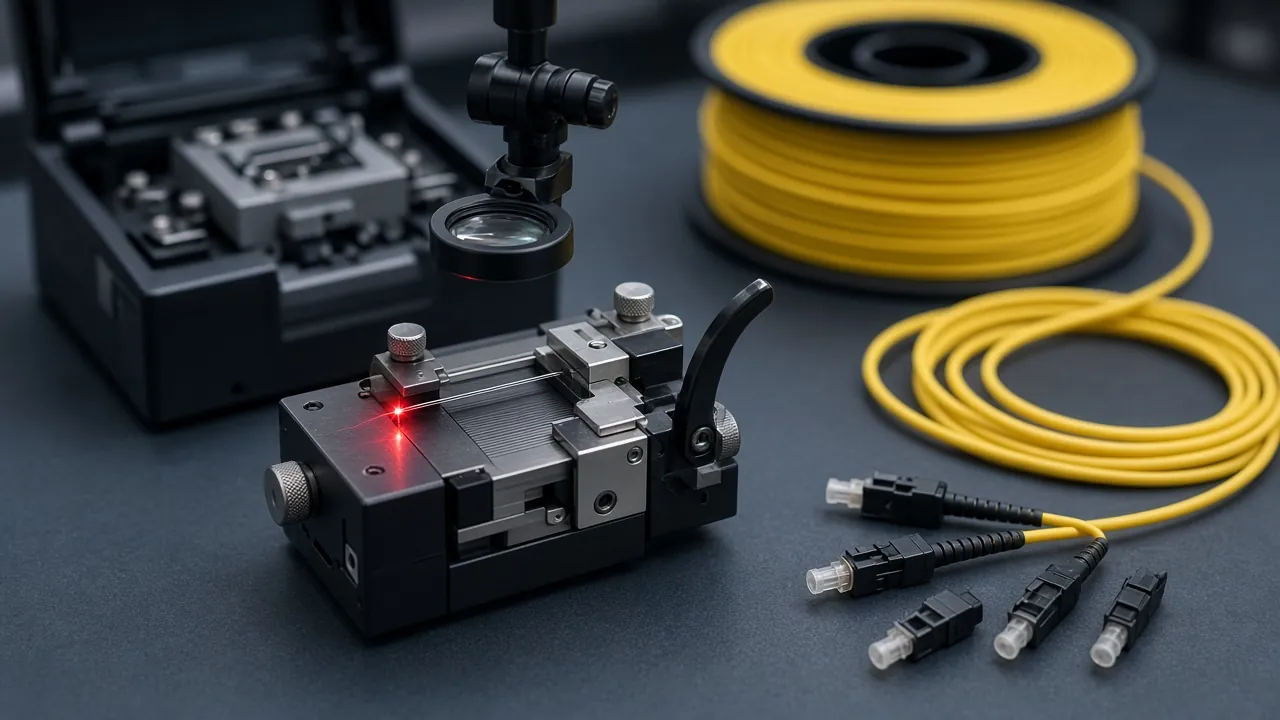
Guiding light
A conventional optical fibre uses a core and cladding with engineered refractive indices to confine optical modes; planar waveguides apply the same principle in a substrate or thin layer. The ICG's TC20 committee links photonic-glass research directly with optical fibres.1
Manufacturing fibres
A preform establishes the material profile before the glass is drawn into fibre. Coating, dimensional control and testing secure handling and optical performance, as Corning describes for its outside vapour deposition process.2
Active and specialty fibres
Doped cores provide optical gain, while composition and geometry tailor transmission and dispersion. Research now extends to fibres with embedded nanoparticles and engineered crystalline inclusions.3
Photonic biosensing
Glass fibres also carry light to and from biological samples: core-clad phosphate glass fibres, for example, have been developed specifically for biosensing.4
Optical data infrastructure
Glass fibre remains the backbone of data networks. In 2024 Lumen reserved 10% of Corning's global fibre capacity for two years to interconnect AI-enabled data centres.5
Planar optics for near-eye displays
In AR glasses, a transparent waveguide carries image light from a compact engine to a designed exit region in front of the eye. SCHOTT reached serial production of geometric reflective waveguides in 2025, built on its own optical glass and ultra-flat wafers.6
Sources
- TC20: Photonic Glasses and Optical FibersInternational Commission on Glass
- Optical Fibre Manufacturing ExcellenceCorning
- ProjectsTampere University · Photonic Glasses group
- Core-clad phosphate glass fibers for biosensingMaterials Science and Engineering: C · 2019
- Corning and Lumen Reach Supply Agreement on Next-Generation Fiber-Optic Cable to Support Data Center AI DemandsLumen Technologies · 1 August 2024
- AR Breakthrough: SCHOTT achieves serial production of Geometric Reflective WaveguidesSCHOTT · 29 September 2025